

Last Updated: November 5, 2026
Quick Summary
To identify high quality dark chocolate, read the ingredients list first, then judge the bar by its snap, aroma, melt and balance rather than cocoa percentage alone. Fewer ingredients, a sharp crack, layered aroma and a clean finish all point to high quality dark chocolate.
- High-quality dark chocolate typically lists cocoa mass, cocoa butter, sugar and perhaps vanilla or lecithin.
- A clean, sharp crack when broken shows the bar was tempered properly.
- Let a small piece melt on your tongue for twenty to thirty seconds before judging it.
- Look for a named origin, a clear date and tight wrapping on the packaging.
- Chocolate is best eaten within months of making, not years.
Table of Contents
- Why Cocoa Percentage Alone Doesn't Tell You Much
- 1. Read the Ingredients List Before Anything Else
- 2. Use a Dark Chocolate Cocoa Percentage Guide
- 3. Check the Snap and Surface of the Bar
- 4. Judge the Aroma Before You Taste
- 5. How to Taste Dark Chocolate Properly
- 6. Look for Balance and Complexity, Not Just Intensity
- 7. Check the Packaging, Origin and Freshness
- Frequently Asked Questions
Why Cocoa Percentage Alone Doesn't Tell You Much
The number on the wrapper is a starting point, not a verdict. A 70% bar can taste flat and waxy while a 64% bar sings with red fruit and roasted nuts. Cocoa percentage tells you how much of the bar came from the cacao bean, but it says nothing about bean quality, fermentation, roasting, or how the maker balanced sugar against cocoa mass. Customers often dismiss a superb 64% bar because it "wasn't dark enough," then buy an 85% bar that tastes harsh. Learning to identify high quality dark chocolate means reading past the percentage and judging the whole bar: ingredients, snap, aroma, melt, and finish. Below, we walk through seven checks we use in our own kitchen, in the order we would actually use them.
1. Read the Ingredients List Before Anything Else
The ingredients list is the fastest honesty test a bar can offer. High-quality dark chocolate typically lists cocoa mass, cocoa butter, sugar, and perhaps a little vanilla or lecithin. If vegetable fat, palm oil, or "flavouring" appears high on the list, the texture will often feel greasy rather than clean. Fewer ingredients usually signal a maker confident in the beans. For broader context on what labels must disclose, the Food Standards Agency guidance on chocolate labelling is worth a read.
2. Use a Dark Chocolate Cocoa Percentage Guide
A dark chocolate cocoa percentage guide helps you match intensity to purpose rather than chasing the highest number. Roughly: 50-60% suits milk-drinkers moving to dark; 60-70% balances sweetness with cocoa depth; 70-80% is the connoisseur's band, where origin flavours show clearly; above 85%, bitterness dominates and the bar becomes an acquired taste. Our Valrhona Guanaja 70% bar sits in that sweet spot, bitter with warm notes, while the Michel Cluizel 85 Bar shows what the top of the scale feels like. Neither is "better", they answer different questions. The trap is assuming higher always means finer. A poorly made high-percentage bar can taste harsh; a well-made 66% like our Valrhona Caraibe Bar, with its roasted dried fruit and slightly oaky finish, can be far more rewarding.


3. Check the Snap and Surface of the Bar
Snap tells you whether the chocolate was tempered properly. Break a piece close to your ear: a clean, sharp crack means the cocoa butter crystals are aligned, which also gives you that glossy shine and clean melt. A dull thud, a crumbly edge, or a greyish film called bloom suggests poor tempering or rough storage. Bloom isn't dangerous, but it signals the bar has been through temperature swings and won't taste as the maker intended. Run a thumb across the surface: it should feel smooth and dry, not tacky. Watch out: a bar that bends rather than snaps has usually absorbed warmth in transit, so check how it was shipped before judging the maker.
4. Judge the Aroma Before You Taste
Most of what you call "taste" starts at the nose. Before biting, hold the piece under your nose and breathe in slowly, then again with your mouth slightly open. A quality bar offers layers: dried fruit, nuts, floral notes, sometimes a whiff of acidity or earth. A flat or faintly cardboard smell usually means old beans or over-roasting. If you get a sharp vinegar or solvent note, the fermentation went wrong. This is where cheap bars reveal themselves fastest, because aroma compounds are the first thing lost to poor handling. Give it ten seconds. If nothing arrives, the bar has little to say.
5. How to Taste Dark Chocolate Properly
Tasting properly means slowing down and letting the chocolate melt rather than chewing it. Place a small piece on your tongue, press it to the roof of your mouth, and let it soften for twenty to thirty seconds. Notice the initial flavour, then the mid-palate, then the finish. Good chocolate changes as it melts and leaves a clean aftertaste; poor chocolate tastes the same throughout and coats your mouth with wax. Breathe out gently through your nose while it melts to catch the aromatics. If you want to build this into a proper session, our guide on how to host a chocolate tasting at home walks through the full setup.
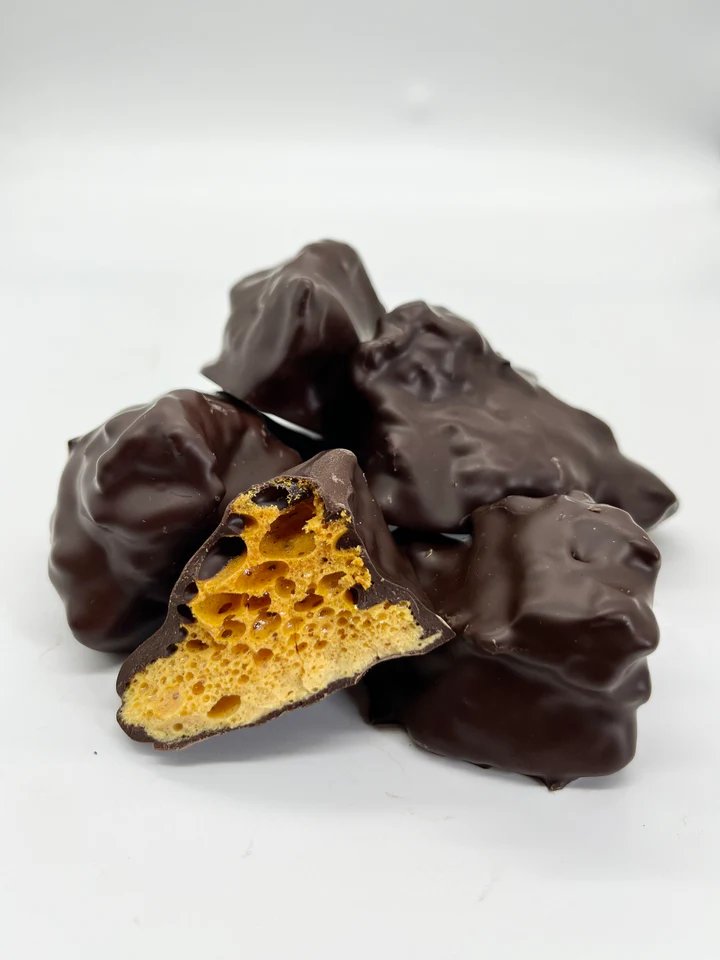
Cinder Toffee: A 2026 Guide to Honeycomb Chocolate
6. Look for Balance and Complexity, Not Just Intensity
Intensity is easy; balance is hard. A great bar holds bitterness, sweetness, acidity, and fruit in tension so no single note bullies the others. When you taste, ask whether the finish is clean or cloying, whether the acidity lifts the flavour or cuts it, whether the sweetness supports the cocoa or masks it. Complexity means you keep finding new notes on the second and third bite. Our Sea Salt Shards in 70% Dark Chocolate use Maldon sea salt, and our Handmade Berry Peppery 70% Dark Chocolate Shards pair black pepper with freeze-dried strawberries. If you enjoy this kind of thinking, our guide on pairing chocolate with craft beer shows how balance plays out alongside another drink.

Handmade Berry Peppery 70% Dark Chocolate Shards
7. Check the Packaging, Origin and Freshness
Packaging and origin details separate serious makers from repackagers. Look for a named origin or at least a country and region, a harvest or best-before date, and storage guidance. Chocolate is best eaten within months of making, not years, and a maker who prints a clear date is telling you they care about freshness. Check that the bar is wrapped tightly and stored away from light and heat. We make our own shards and dipped fruits in small batches and date them clearly, because freshness is part of flavour. For practical advice on keeping a bar at its best once it's home, see our guide on storing artisanal chocolates. A bar with no origin, no date, and vague packaging is usually hiding something.
Check |
What Good Looks Like |
What to Avoid |
|---|---|---|
Ingredients |
Cocoa mass, cocoa butter, sugar, vanilla |
Vegetable fat, palm oil, vague "flavouring" |
Cocoa percentage |
Clearly stated cocoa solids |
No figure given |
Snap and surface |
Sharp crack, glossy, dry |
Dull thud, crumbly, grey bloom |
Aroma |
Layered fruit, nuts, floral |
Flat, cardboard, solvent |
Taste |
Changes as it melts, clean finish |
Same throughout, waxy coating |
Balance |
Bitterness, sweetness, acidity in tension |
One note dominating |
Packaging |
Named origin, clear date, tight wrap |
No origin, no date |
Identifying high quality dark chocolate comes down to slowing down and using your senses in order: read, snap, smell, taste, then judge balance and provenance. The percentage is a signpost, never the destination. At Gorvett & Stone, we hand-make our chocolates in small batches using fine, sustainably sourced couverture, and we are always happy to talk through which bar suits your palate. Explore our range of handmade chocolates and find the bar that earns its place on your shelf.
Frequently Asked Questions
How can you tell if dark chocolate is high quality?
Start with the ingredients list: a high quality dark chocolate should list cocoa mass or cocoa beans, cocoa butter, sugar and perhaps a little vanilla, with no vegetable fats in place of cocoa butter. Then check the snap, which should be clean and sharp, and the aroma, which should smell of cocoa rather than sugar. A high quality dark chocolate also melts smoothly on the tongue and leaves a clean finish rather than a waxy or greasy coating.
Does a higher cocoa percentage mean better dark chocolate?
No. Cocoa percentage tells you how much of the bar comes from cocoa solids and cocoa butter combined, not how good it is. A 70% bar made with well-fermented beans and proper conching can taste far better than an 85% bar made from poor-quality beans. Use a dark chocolate cocoa percentage guide to pick a starting point, but let the ingredients and the flavour decide. Many people find 64% to 70% the most balanced range.
What should high-quality dark chocolate taste like?
Expect a clear cocoa flavour with layers behind it: dried fruit, roasted nuts, citrus or floral notes depending on the bean. Bitterness should be present but not harsh, and any sourness should read as bright rather than sharp. The texture should be smooth and the finish clean. If a bar tastes only of sugar, or turns gritty or waxy, the ingredients or the processing are letting it down.
How should you store dark chocolate to preserve its flavour?
Keep it in a cool, dark place at a steady temperature, ideally between 15°C and 18°C, away from direct sunlight and strong smells. Wrap it tightly or keep it in an airtight container, because cocoa butter absorbs odours easily. Avoid the fridge for everyday storage, as condensation and food smells can spoil the surface. If a bar develops a pale grey bloom, it is still safe to eat, but the texture will be affected.
Why does dark chocolate sometimes taste bitter or sour?
Bitterness and sourness come from the beans, the fermentation and the roasting, not just the cocoa percentage. Under-fermented beans can leave sharp, vinegary notes, while over-roasting pushes bitterness forward. A well-made high quality dark chocolate balances these notes so they read as complexity rather than a flaw. If a bar tastes harsh or astringent, try a lower percentage or a different origin before assuming all dark chocolate tastes that way.

Leave a comment