


Last Updated: November 7, 2026
Quick Summary
The history of traditional British cinder toffee runs from late seventeenth-century household manuscripts, where sugar was boiled hard and aerated, through eighteenth and nineteenth-century commercial production, to its role as a fairground and seaside staple sold in paper bags.
- The technique of boiling sugar to a crack stage and aerating it appears in British household recipe collections by the late seventeenth century.
- Falling refined-sugar prices and reliable raising agents moved boiled sweets from the manor house into commercial production.
- Cinder toffee is the name most associated with northern England and Scotland, where the same sweet also appears as puff candy.
- The syrup is cooked to the hard-crack stage, roughly 150°C, then taken off the heat and beaten with bicarbonate of soda.
- Handmade versions come in 250g bags and soften and turn stickier as they mature, which is a feature, not a fault.
Table of Contents
- What Is Cinder Toffee?
- Cinder Toffee Origins: Tracing a British Sweet Through the Centuries
- Cinder Toffee and Honeycomb: What Is the Difference?
- How Cinder Toffee Is Made: From Boiling Sugar to Brittle Shards
- Regional Names and Social History: Hokey Pokey and Beyond
- How Cinder Toffee Changed Over Time: Ingredients and Technique
- Choosing Handmade Cinder Toffee for Gifting
- Frequently Asked Questions
What Is Cinder Toffee?
Cinder toffee is a traditional British sweet made from boiled sugar and golden syrup, aerated with bicarbonate of soda so that it sets into a light, brittle, honeycomb-textured slab. The history of traditional British cinder toffee runs from seventeenth-century household manuscripts to seaside stalls,
The chemistry is simple and unforgiving. Sugar syrup is heated to the hard-crack stage, bicarbonate of soda is whisked in, and the sudden release of carbon dioxide foams the mixture into thousands of tiny bubbles. It sets in minutes. Break it open and you get a glassy, porous structure with a toasty, slightly bitter edge from caramelisation.
That bitterness is the point. It is what separates a proper cinder toffee from a sweet that just tastes of sugar.
The Ingredients Behind the Bubbles
Four ingredients do all the work: sugar, golden syrup or treacle, bicarbonate of soda, and a little water. Golden syrup keeps the mixture from crystallising and adds a mellow, buttery note; treacle or molasses pushes it darker and stronger.
The bicarbonate is the leavening agent. Add too little and the slab is dense and tooth-breaking. Add too much and it tastes soapy and collapses. UK Food Standards Agency guidance on food additives sets out what bicarbonates are and how they are regulated in food.
Cinder Toffee Origins: Tracing a British Sweet Through the Centuries
Cinder toffee origins are genuinely murky, and any article that gives you a neat single date is guessing. What we can say with confidence is narrower and more useful: the technique of boiling sugar to a crack stage and aerating it appears in British household recipe collections by the late seventeenth century, and the sweet has been made in kitchens and shops ever since. The honest way to tell that history is to separate what is documented from what is later tradition.
A workable chronology looks like this. Before the late seventeenth century, sugar reached British kitchens as conical loaves that had to be broken down and had their molasses drained off, which made confectionery a skilled, labour-heavy job. From the late seventeenth century, household manuscripts begin to record puffed, honeycomb-like sugar sweets. Through the eighteenth and nineteenth centuries, falling refined-sugar prices and the arrival of reliable raising agents moved boiled sweets from the manor house into commercial production. By the late nineteenth and early twentieth centuries, cinder toffee was a fairground and seaside staple sold in paper bags.
We treat the history as evidence-led rather than tidy. The earliest printed recipes are not always called cinder toffee, and the same sweet turns up under a dozen regional names. That is normal for a domestic confection passed hand to hand rather than manufactured to a standard. Where a claim is disputed, we label it as disputed rather than repeating it as fact.
The 1682 Manuscript and Early Recipe Evidence
It is not called cinder toffee, and it is not a modern recipe in any recognisable sense, but the method, sugar boiled hard and seeded with something that foams, is the same family of sweet.
Treat such manuscripts as evidence of practice, not proof of a brand name. They tell us that cooks were experimenting with aerated sugar long before the sweet had a fixed identity. Read them alongside later printed cookbooks and you can see the technique being refined rather than invented: the same hard-crack boil, the same aeration, but with ingredients and equipment that changed around it. For a broader look at how the sweet developed, our cinder toffee guide covers the chocolate honeycomb side in more depth.
From Conical Pots to Seaside Stalls
The sweet's social history is a story of movement: from the domestic kitchen to the sweet shop, and from the sweet shop to the seaside. Conical sugar loaves had to be broken down and molasses drained off before sugar could be used at all, which made confectionery a skilled, labour-heavy job.
As refined sugar became cheaper through the eighteenth and nineteenth centuries, boiled sweets moved out of the manor house and into commercial production. Cinder toffee became a fairground and seaside staple, sold in paper bags, often broken into irregular shards rather than cut into neat squares. That working-sweet history is easy to lose behind the modern gift-box image, and it is the part of the story most worth keeping.
Cinder Toffee and Honeycomb: What Is the Difference?
In practice, cinder toffee and honeycomb are the same sweet under two names. Both are aerated boiled sugar; both rely on bicarbonate of soda for their bubbles; both have that glassy, porous crunch. The difference is regional habit and marketing, not recipe. Where competitors tend to stop at that sentence, the useful part is the comparison underneath it.
Set the names side by side and the pattern is clear. Cinder toffee is the name most associated with northern England and Scotland, where the same sweet also appears as puff candy. Honeycomb is the paler, more generic shop name, and it is the term that travels best in chocolate-coated form.
Where a distinction is drawn, it usually comes down to colour and sugar source. A darker version made with treacle or molasses may be sold as cinder toffee, while a paler golden version is called honeycomb. Chocolate coating muddies the naming further, since a chocolate-covered honeycomb bar and a chocolate-covered cinder toffee are, functionally, the same thing.
Cinder toffee is an aerated boiled-sugar confection, and honeycomb is the same sweet sold under a different regional name. If you are buying or making it, judge by texture and flavour, not by the label.
The same sweet travels under several names, and the differences are regional habit rather than recipe.
| Name | Where it is used | Note |
|---|---|---|
| Cinder toffee | Northern England and Scotland | Darker versions may use treacle or molasses |
| Puff candy | Northern England and Scotland | Another name for the same sweet |
| Honeycomb | Generic shop name | Paler, golden version; travels best chocolate-coated |
| Hokey pokey | New Zealand, parts of northern England and Scotland | The name that travelled furthest |
How Cinder Toffee Is Made: From Boiling Sugar to Brittle Shards
Making cinder toffee is a short, hot, high-stakes process. Sugar, syrup and water go into a heavy pan and are brought to a rolling boil without stirring, because stirring invites crystallisation. The syrup is cooked to the hard-crack stage, roughly 150°C, then taken off the heat and beaten with bicarbonate of soda.
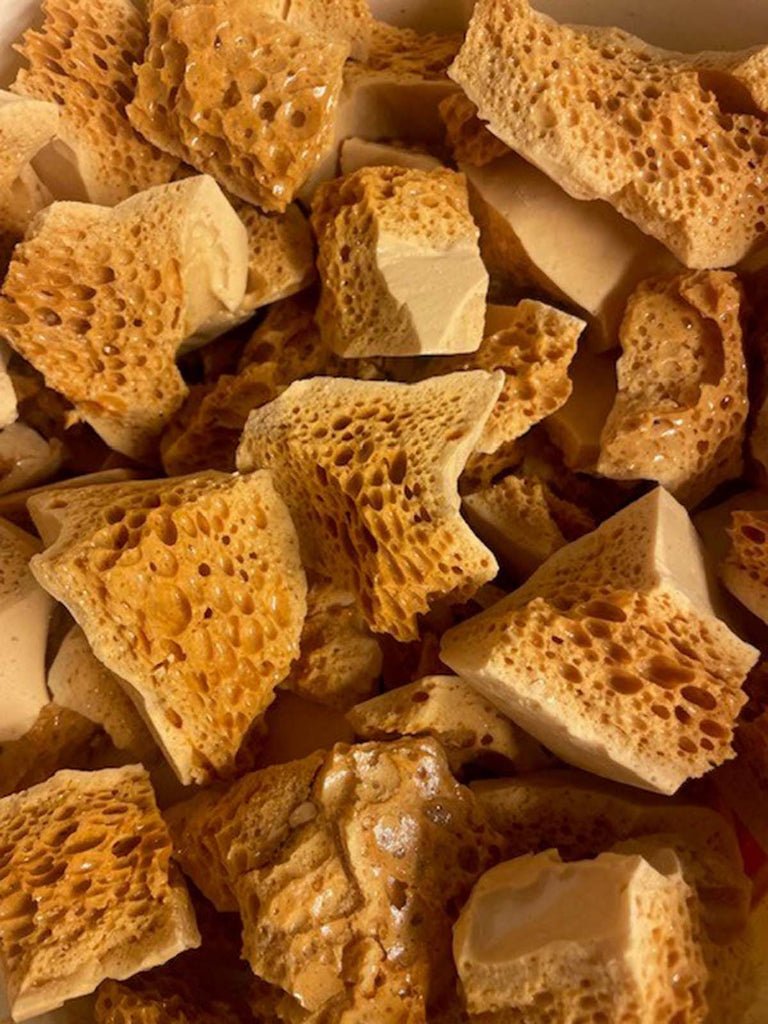
The mixture foams violently, is poured immediately into a lined tin, and sets as it cools. Timing is everything: pour too late and the bubbles collapse, pour too early and the slab is tough. Watch out: adding the bicarbonate while the pan is still on the heat can cause the foam to boil over and burn. If yours turns sticky in storage, our guide on how to prevent cinder toffee getting sticky explains why.
Regional Names and Social History: Hokey Pokey and Beyond
Hokey pokey is the best-known regional name for the sweet, and it is the name that travelled furthest. In New Zealand, hokey pokey is a national institution; in parts of northern England and Scotland, the same sweet appears as cinder toffee, puff candy, or honeycomb.
The variation is a map of migration and local dialect. Boiled sweets were cheap, portable and made from ingredients every kitchen had, so the recipe spread with people rather than through cookbooks. Different towns named it after what it looked like, how it broke, or what it was sold alongside.
That social history matters. Cinder toffee was never a luxury confection; it was a working sweet, made in batches and sold by weight. Its revival as a premium, chocolate-coated gift is a recent chapter, not the whole story.
How Cinder Toffee Changed Over Time: Ingredients and Technique
The biggest change to cinder toffee over three centuries is the sugar itself. Early recipes worked from sugar loaves, which had to be broken and had molasses drained from them; refined, free-flowing sugar and tins of golden syrup made the sweet dramatically easier to produce.
Technique changed too. Commercial thermometers replaced the practised eye and the cold-water test, and bicarbonate of soda became a reliable, standardised raising agent rather than a novelty. Industrial production made the texture more consistent, but it also flattened the variation that made regional versions distinct.
What has not changed is the underlying reaction. Heat drives caramelisation, bicarbonate releases carbon dioxide, and the cooling syrup traps it. Any version that skips that sequence is not cinder toffee, whatever the packet says.
Choosing Handmade Cinder Toffee for Gifting
Handmade cinder toffee makes a strong gift because it is recognisable, nostalgic and genuinely difficult to make well at home. The variables that decide quality, sugar temperature, aeration, setting time, are the ones a small-batch maker controls closely and a factory optimises for shelf life instead.
We make ours with local Oxfordshire honey and coat it in sustainably sourced milk chocolate. The milk chocolate cinder toffee is the crowd-pleaser, with a smooth, mellow coating over the bubbly shards; the dark chocolate cinder toffee uses 70% dark chocolate for anyone who prefers a sharper, less sweet finish. Both come in 250g bags and soften and turn stickier as they mature, which is a feature, not a fault.


Best for: hosts, corporate gifts and anyone who wants a British sweet with a story behind it. Skip if: you need a long shelf life and a firm snap right up to the last piece.
Cinder toffee rewards a maker who respects the heat and a buyer who knows what they are looking at. If you want the real thing, made in small batches with proper ingredients, Gorvett & Stone handmakes chocolate honeycomb in milk and 70% dark, using local Oxfordshire honey and sustainably sourced couverture. Browse the range and find the tin or bag that suits the occasion. Get started with Gorvett & Stone and give a sweet with three centuries behind it.
Frequently Asked Questions
Why is cinder toffee called cinder toffee?
The name likely comes from the sweet's dark, blistered surface, which resembles cooled cinders from a fire. Early batches made with darker sugars and treacle could look almost burnt, and the porous, bubbly structure reinforced the comparison. Regional names vary widely, including honeycomb, hokey pokey and puff candy, but cinder toffee remains the most common term across much of the country.
Is cinder toffee the same as honeycomb?
In practice, the two names usually describe the same sweet. The cinder toffee and honeycomb difference is mostly one of naming and regional habit rather than ingredients or technique. Some makers reserve honeycomb for the paler, golden version and cinder toffee for a darker batch made with treacle, but both rely on sugar, syrup and bicarbonate of soda to create the characteristic bubbly texture.
How does cinder toffee get its bubbly texture?
The bubbles come from a chemical reaction. When bicarbonate of soda is stirred into hot sugar syrup, it breaks down and releases carbon dioxide gas. The syrup is thick enough to trap that gas, and as the mixture cools and sets, the bubbles remain fixed in place, giving cinder toffee its porous, crunchy structure and light texture.
How should cinder toffee be stored to keep it crisp?
Cinder toffee can draw moisture from the air and turn sticky over time. Keep it in an airtight container in a cool, dry place. Chocolate-coated versions keep slightly better, and as the listing notes, they become lusciously sticky and softer as they mature.

Leave a comment